

PML
Iron Filing Removal Machine
Iron Filing Removal Machine


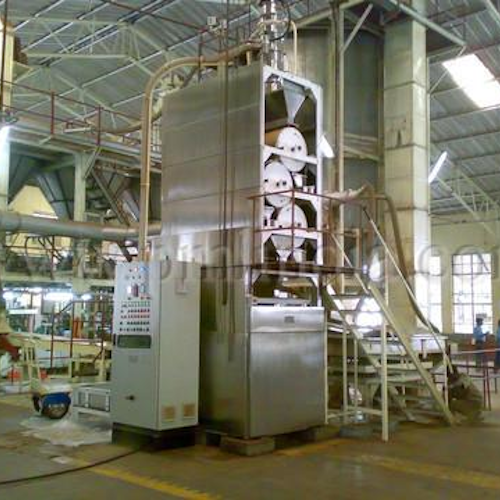
Product Details
At a Glance
An IFR (Iron Free Rate) machine is a dedicated iron-removal system engineered for high-purity processing, such as tea, installed between storage and blending to bring contamination down to strict parts-per-million levels. PML's IFR machine processes up to 4,500 kg of tea per hour, reducing contamination to no more than 30 ppm of pure iron or 400 ppm of iron mixed with tea.
Iron is one of the most abundant materials in industrial machinery, which means most processed products pick up some level of iron contamination simply from the equipment that handles them. In food processing, permissible contamination levels are governed by BIS and other international standards — and individual devices like drums, pulleys, grills or plates, deployed in isolation, often can't bring contamination down far enough on their own. The PML Iron Filing Removal (IFR) Machine combines several of these technologies into one engineered system to solve that.

Built for Tea Processing
This system is engineered specifically to remove iron from tea, installed between the tea storage area and the blending station. It processes up to 4,500 kg of tea per hour, bringing contamination down to no more than 30 ppm of pure iron, or 400 ppm of iron mixed with tea. Actual output quality depends on input quality, flow rate, contamination particle size and the specific magnetic systems configured — we work with you to calculate a cleaning ratio that measures the system's real-world efficiency for your product.

How the System Works
Tea is fed from 35 kg bags into an input bin at ground level. A vacuum feeding system carries it up to a hopper, from where it's released onto a series of magnetic drum separators. As tea passes over each drum, iron particles adhere to the drum's surface under the internal magnet's field and are separated into collection trays, while cleaned tea continues to the next stage. The full installation occupies roughly 15 square metres of floor space and stands about 5.5 metres tall, comprising an input bin, vacuum feeding system, magnetic drum separators, geared motor drive and control panel.


Note: this system is engineered for free-flowing dry products like tea and is not suitable for materials with high viscosity or large particle sizes by volume or weight.

Key Advantages
- Down to 30 PPM
A comprehensive multi-stage system that achieves iron removal levels a single device typically can't reach alone.
- PLC-Controlled
Flexible flow rates and enhanced safety features, with production capacity scalable from 3.5 to 4.5 tonnes per hour.
- Three-Drum Design
Combined with a magnetic grill stage, the three-drum separator configuration takes input contamination from 400 ppm down to as low as 30 ppm output.
- Purpose-Engineered
Built and configured around your specific product and throughput, not a one-size-fits-all unit.
Frequently Asked Questions
Is this only for tea?
The standard system is engineered specifically for tea processing, but the same multi-stage magnetic drum and grill approach can be adapted for other dry, free-flowing products — talk to our engineering team about your material.
What throughput can it handle?
Up to 4,500 kg per hour, with capacity scalable from 3.5 to 4.5 tonnes per hour depending on configuration.
What contamination level can I expect?
Under standard conditions, the system brings iron contamination down to 30 ppm pure iron or 400 ppm iron mixed with product — actual results depend on your input quality and material characteristics, which is why we calculate a cleaning ratio specific to your process.
How much floor space and height does the installation need?
The full installation occupies roughly 15 square metres of floor space and stands about 5.5 metres tall.
What does the system consist of?
An input bin, vacuum feeding system, magnetic drum separators, geared motor drive and control panel — combined with a magnetic grill stage in a three-drum configuration.
Why Buy From PML
- 65+ years of magnetic separation engineering — combining drum separators, grills and control systems into complete, engineered solutions.
- Built and tested in-house — every system is engineered and validated against your product before installation.
- Proven in production — PML IFR systems are in service at major tea processing operations.
- Ongoing support — magnetic calibration and audit services available after installation.
Processing a different product and need contamination levels this low? Enquire now and our engineering team will assess your process.
Why Magnetic Strength Drops in Ferrous Separators (and When to Replace)
Separation efficiency falls as magnetic strength decreases. Below are the most common causes of reduced field strength in NdFeB (neodymium) magnetic separation equipment, along with the warning signs that indicate a magnet or separator needs replacing.
Causes of Reduced Magnetic Strength
- Thermal demagnetization: Standard Neodymium-Iron-Boron (NdFeB) grades lose magnetic strength when exposed to temperatures above their rating — often starting at 80°C / 176°F for standard grades. Exceeding these limits causes a permanent loss of magnetic flux.
- Corrosion and core oxidation: NdFeB is highly iron-rich and oxidizes quickly. If moisture, washdown liquids, or corrosive chemicals breach the outer stainless steel cladding, the magnet swells, crumbles, and loses field strength.
- Mechanical damage and internal cracking: NdFeB is brittle. Dropping magnetic tubes during cleaning, or subjecting them to heavy equipment vibration, causes internal micro-fractures that break the continuous magnetic circuit.
- Strong opposing magnetic fields: A sufficiently strong opposing field can overcome a material's coercivity and flip or randomize its magnetic domain polarity. High alternating current (AC) electric fields, in particular, create powerful local alternating magnetic fields that rapidly scramble domain alignment.
- Material buildup ("air gap" effect): Accumulated fine iron on the surface acts as a barrier, pushing the active magnetic field further away from incoming material. Because magnetic force decays exponentially with distance, even a few millimetres of buildup severely reduces capture rates.
- Increased process velocity or burden depth: Running material too fast, or in overly thick layers, prevents fine ferrous particles from spending enough time in the peak magnetic field zone to be pulled out of the flow.
Signs an NdFeB Magnet or Separator Needs Replacing
- Drop in gauss rating: Annual or semi-annual gauss testing shows a permanent drop of 10–15% or more from the baseline specification.
- Bulging or "pillow" swelling: The protective stainless steel tube cladding looks warped, swollen, or cracked — a sign of internal oxidation where rust has expanded inside the shell.
- Dead spots along the field: Measuring with a gauss meter reveals localised spots with zero or drastically lower magnetic pull across the grid or tube surface.
- Downstream metal contamination: Ferrous fines or tramp iron start showing up in final product testing or downstream machinery detectors despite the separator being clean.
- Structural casing punctures: Scratches, gouges, or pinhole leaks in the stainless steel jacket expose the internal magnetic circuit to moisture and process fluids.
Regular gauss testing (at least annually) is the most reliable way to catch strength loss before it affects downstream product purity — PML's own range of Gaussmeters and magnetic field meters covers this. If you're seeing any of the signs above, talk to our team about testing or replacing your separator.
You may also like
-
-
-
Magnetic Rods
Regular price From Rs.2,150.00Regular price


