


Product Details
At a Glance
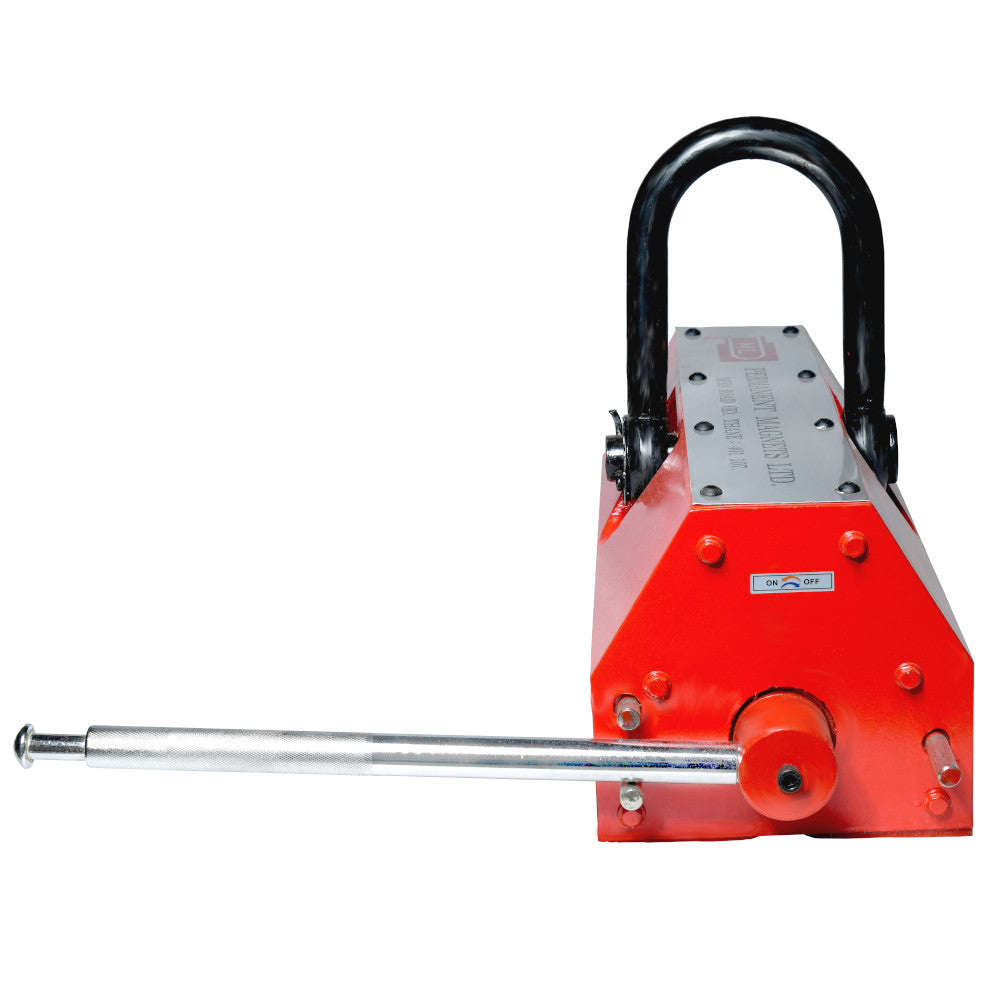
A magnetic lifter (also called a magnetic lifting device or magnetic lift system) moves ferromagnetic material without slings, clamps or hooks to rig, holding with a fixed permanent-magnetic field that needs no external power source. PML's 2x factor-of-safety lifters range from 400 kg to 5,000 kg capacity for standard-duty lifting.
Magnetic lifters — also called magnetic lifting devices or magnetic lift systems — move ferromagnetic material without slings, clamps or hooks to rig. Because PML permanent magnetic lifters hold with a fixed magnetic field, they need no external power source: simpler in design, nothing to fail, and nothing to pay for after the day you buy one.
This range carries a 2× factor of safety and spans lifting capacities from 400 kg to 5 tonnes. Those ratings are the maximum weight each lifter handles safely under ideal conditions — always select a model whose capacity matches or exceeds your intended load, and read the capacity guidance further down this page before choosing. For oversized steel plates, multiple lifters can be used together.

| PERMANENT MAGNETIC LIFTER MODELS WITH 2 TIMES FACTOR OF SAFETY | |||||||
|---|---|---|---|---|---|---|---|
| Model No. | Lifting Capacity | Dimension (In mm) | MS Sheet Thickness Recommendation | Self Weight | |||
| Flat Surface | L | B | H | R | (In Kgs) | ||
| 812-1 | 400 Kg. | 157 | 90 | 93 | 210 | ≥ 10 | 10 |
| 813-1 | 600 Kg. | 210 | 120 | 115 | 230 | ≥ 20 | 20 |
| 814-1 | 1000 Kg. | 256 | 142 | 135 | 280 | ≥ 25 | 36 |
| 816-1 | 2000 Kg. | 347 | 166 | 165 | 360 | ≥ 35 | 68 |
| 817-1 | 3000 Kg. | 432 | 166 | 165 | 360 | ≥ 35 | 92 |
| 818-1 | 5000 Kg. | 530 | 225 | 220 | 590 | ≥ 55 | 198 |
Where These Lifters Are Used
Wherever ferromagnetic material has to be lifted, positioned or transported, a magnetic lifter shortens the job:
- Manufacturing and fabrication — handling metal sheets, plates, beams, pipes and components, streamlining material flow
- Construction — lifting and positioning steel structures, beams and columns during installation
- Warehousing and logistics — loading, unloading, organising and stacking metal products
- Scrap metal and recycling — separating and handling ferrous material, simplifying sorting and preparation
- Shipbuilding and offshore — handling heavy plates, sections and equipment during build, maintenance and repair
- Automotive and machinery manufacturing — positioning engine blocks, chassis and large machine parts
- Mining and extractive industries — transporting iron ore and other ferromagnetic materials
- Foundries and metal casting — handling and positioning moulds, cores and castings
Construction
Inside the lifter, Nd-Fe-B high-performance permanent magnetic material generates an exceptionally strong field. A core shaft, switched by the hand lever, turns that field ON or OFF at the base of the lifter, where it forms a pair of longitudinal magnetic poles that grip the workpiece. The attraction surface carries a V-shaped groove, so the same lifter handles both flat (plank-shaped) and round (column-shaped) workpieces.
Selecting the Right Lifter — What Actually Determines Capacity
Rated capacity is only the starting point. Six factors decide what a magnetic lifter will really hold, and we would rather you know them before you buy than after:
- Workpiece thickness and weight. Thin material carries fewer magnetic lines of force, so capacity derates below the rated minimum thickness. The conversion table below relates material thickness to load-capacity ratio.
| Material Thickness | Load capacity ratio | |||||||
| mm | inch | 818-1 (5000kgs) |
817-1 (3000kgs) |
816-1 (2000kgs) |
814-1 (1000kgs) |
813-1 (600kgs) |
812-1 (400kgs) |
|
| T1 | UP90 | UP3.54 | 100% | 100% | 100% | 100% | 100% | 100% |
| T2 | 80 | 3.15 | 95% | |||||
| T3 | 75 | 2.95 | 90% | |||||
| T4 | 70 | 2.76 | 85% | |||||
| T5 | 65 | 2.56 | 80% | |||||
| T6 | 60 | 2.36 | 75% | |||||
| T7 | 55 | 2.16 | 70% | 95% | ||||
| T8 | 50 | 1.97 | 65% | 90% | 95% | |||
| T9 | 45 | 1.77 | 60% | 85% | 90% | |||
| T10 | 40 | 1.57 | 55% | 80% | 85% | |||
| T11 | 35 | 1.38 | 50% | 70% | 75% | 90% | ||
| T12 | 30 | 1.18 | 40% | 60% | 65% | 80% | ||
| T13 | 25 | 0.98 | 30% | 50% | 55% | 70% | 90% | |
| T14 | 20 | 0.79 | 20% | 40% | 45% | 60% | 75% | 90% |
| T15 | 15 | 0.59 | 16% | 30% | 35% | 50% | 60% | 70% |
| T16 | 10 | 0.39 | 10% | 20% | 25% | 35% | 45% | 50% |
| T17 | 5 | 0.2 | 6% | 10% | 15% | 20% | 25% | 30% |
- Air gap. The magnet must sit tight on the workpiece; any gap between pole face and load weakens the grip. Choose a lifter that generates the required force at your real-world contact conditions.
- Workpiece material. Magnetic lifters hold ferromagnetic materials (iron, steel). Aluminium, copper and other non-ferromagnetic materials need a different handling method — and we will tell you so.
- Attraction area. The magnet's pole faces should be adequately covered by the workpiece surface for a secure grip.
- Weight balance. Lift from the centre of gravity; an unbalanced load can tilt or move uncontrollably.
- Surface roughness. Smooth surfaces give better contact and stronger attraction. Rough surfaces (above 6.3 µm) reduce capacity and increase the effort needed on the handle.

Actual capacity is estimated with the conversion formula Tx × Fx × Mx × rated lifting weight (kg), where Tx, Fx and Mx are the thickness, surface-finish and material factors above.
Installation and Operation
- Choose a mounting/working surface that is strong, flat, clean and free of debris, capable of supporting lifter and load.
- Position the lifter aligned to the lifting direction and load location; where the design provides mounting holes, fasten securely to the manufacturer's torque specifications.
- Verify stability before use: gently apply pressure to confirm the lifter is secure, then test lifting function in a controlled manner before the first real load.

- Estimate real capacity from your workpiece's material, thickness and surface quality using the conversion factors above.
- Maximise the contact area between lifter and workpiece — a larger attracting area means a stronger grip.
- Expect higher handle effort on column-shaped or thin workpieces with rough surfaces and small contact areas.
- Operate below 80 °C, away from violent shaking, impact, and metal-eroding agents.
- Lift from the load's centre of gravity. Switch the handle from OFF to ON only after confirming the slide key is locked, and move smoothly — shaking can drop the workpiece.
- For round (column-shaped) workpieces, seat the V-groove on the workpiece and derate capacity to 30–50% of rated, depending on diameter.
- Keep single-lifter workpieces under 3000 mm in length; beyond that, distribute the load across multiple lifters.
- After the lift, release the slide key from the positioning lock, return the handle to free, switch OFF and remove the lifter.

Maintenance and Safety
- Never operate the lifter without a load attached (no idle-load operation).
- Never exceed the rated capacity — overloading is strictly forbidden.
- Never stand under or pass through the path of a hoisted workpiece.
- Begin moving the load only after it is safely lifted and secure.
- Do not turn the handle unless a magnetisable workpiece is seated on the lifter's base.
- Regularly inspect the slide key and positioning bolt — they must be reliable, locked and secure.
- Keep the absorbing surface clean and flat; remove impurities that reduce grip.
- Avoid striking or impacting the lifter.
- Re-test and re-certify the lifter every two years in service.
Frequently Asked Questions
Which capacity should I choose?
Choose a model whose rated capacity meets or exceeds your heaviest load — then check the derating factors on this page for thickness, surface finish and material. If in doubt, send us your workpiece details and our engineers will size it for you honestly.
Can these lifters handle round bars?
Yes — the V-groove in the attraction surface seats column-shaped workpieces. Derate capacity to 30–50% of rated for round work, depending on diameter.
Do they work on stainless steel or aluminium?
Magnetic lifters hold ferromagnetic materials such as iron and mild steel. Aluminium and copper are non-magnetic, and most stainless grades conduct magnetic force poorly — for those, a different handling method is the right answer.
How often should the lifter be tested?
Perform demarcation and testing every two years in service, and inspect the slide key and positioning bolt regularly.
What's the maximum single-lifter workpiece length?
3000mm — beyond that, distribute the load across multiple lifters.
What operating temperature limit applies?
80°C, and away from violent shaking, impact and metal-eroding agents.
Why Buy From PML
- 65+ years of magnetic expertise — Permanent Magnets Ltd has designed and manufactured magnetic products for 65+ years, and our consumer range is built to the same engineering standards we supply to global industrial leaders.
- Made and tested in-house — magnets, assemblies and finished products are manufactured and quality-checked at our own facilities, so every unit performs to its stated specification.
- Honest specifications — the ratings you read on this page are the ratings you get. If your application needs a different size or strength, our engineers will tell you exactly what works — and what won't.
- Support from real engineers — from product selection to after-sales, your questions are answered by the team that builds the product.
Need help choosing, or a custom specification? Chat with our team on WhatsApp and we will help you find the right fit.
You may also like
-
Magnetic Lifters 3 times FOS
Regular price From Rs.9,200.00Regular priceRs.0.00Sale price From Rs.9,200.00 -
Double Circuit Magnetic Lifter
Regular price From Rs.21,800.00Regular price -
Magnetic Bulk Parts Lifter
Regular price From Rs.1,800.00Regular price


