


PML
Easy Clean Magnetic Grill
Easy Clean Magnetic Grill
Starting from Rs.11,577
Download Catalogue (PDF)


Product Details
At a Glance
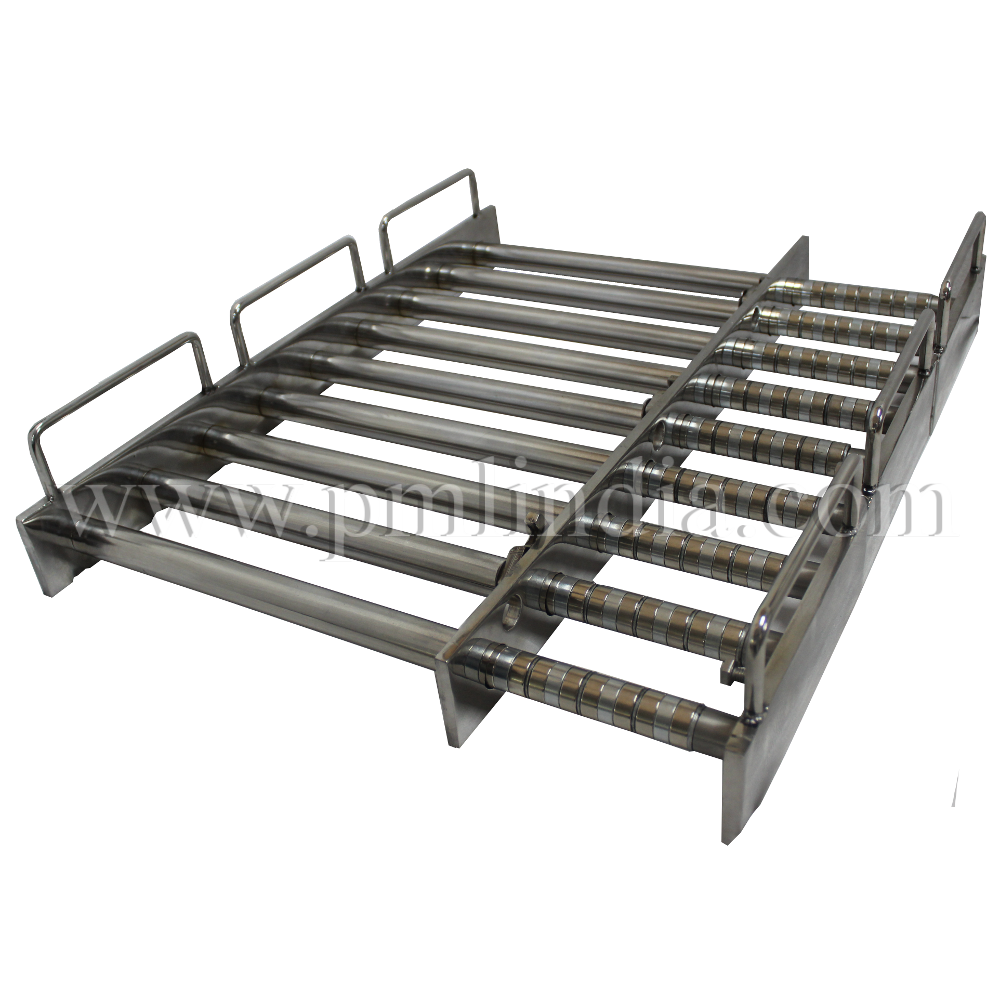
An easy clean magnetic grill fits into a hopper to arrest iron particles, with each magnetic rod resting inside a hollow stationary sleeve so cleaning is a single slide-out action instead of pulling, wiping and refitting each rod individually. PML's easy clean grills use the same Stainless Steel 304/316 and ferrite or NdFeB rod construction as PML's standard grills.
A standard magnetic grill works well until cleaning it becomes the bottleneck — pulling rods, wiping each one down, refitting them, all while the line waits. The PML Easy Clean Magnetic Grill is built specifically around that moment: fitted into a hopper to arrest iron particles from dry, free-flowing material, with a cleaning mechanism designed to take seconds, not minutes.
How the Easy-Clean Mechanism Works
Each magnetic rod rests inside a hollow, stationary stainless steel sleeve. To clean the grill, remove it from the hopper, slide open the interlock, and slide the magnetic rod out of the sleeve. The moment the rod clears the sleeve, it loses contact with the magnetic circuit — the trapped ferrous particles simply fall away, with no scraping or wiping required. Slide the rod back in and the grill is ready to go again.
Key Advantages
- Seconds, Not Minutes, to Clean
The sleeve-and-rod design drops the captured iron the instant the rod is withdrawn.
- Maintenance-Free
No power, no wear parts to service — just periodic cleaning.
- High-Intensity Capture
9,000 ± 500 Gauss on the sleeve surface, enough for fine ferrous fines.
- Standard or Custom Sizing
Nine standard frame sizes, or a custom build to match your hopper opening.
Standard Range — High-Intensity, 9,000 ± 500 Gauss, Max. Operating Temp. 80°C
| Model No. | Magnets | Dimensions (A×B mm) | No. of Magnetic Elements |
| ECHSG-150 | NdFeB | 150×150 | 2 |
| ECHSG-200 | NdFeB | 200×200 | 3 |
| ECHSG-250 | NdFeB | 250×250 | 4 |
| ECHSG-300 | NdFeB | 300×300 | 5 |
| ECHSG-350 | NdFeB | 350×350 | 5 |
| ECHSG-400 | NdFeB | 400×400 | 6 |
| ECHSG-450 | NdFeB | 450×450 | 7 |
| ECHSG-500 | NdFeB | 500×500 | 8 |
| ECHSG-550 | NdFeB | 550×550 | 9 |
| ECHSG-600 | NdFeB | 600×600 | 10 |
Frequently Asked Questions
How is this different from a standard magnetic grill?
The rods sit in a stationary hollow sleeve rather than being pulled and wiped directly — withdrawing the rod alone drops the trapped iron, cutting cleaning time significantly versus a standard grill.
What contamination level is it built for?
It's most efficient where iron contamination is within roughly 1–1.5% by weight of the product. For higher contamination levels, our Drawer or Multi-Drawer Grills are the better fit.
Can I get a custom size?
Yes — beyond the ten standard sizes, custom dimensions are available to match your exact hopper opening.
What magnet material and Gauss rating does it use?
NdFeB rare-earth magnets rated at 9,000 ± 500 Gauss, with a maximum operating temperature of 80°C.
How many magnetic elements does the largest size have?
The largest standard model (600×600mm) has 10 magnetic elements; the smallest (150×150mm) has 2 — see the table above for every size in between.
Why Buy From PML
- 65+ years of magnetic separation engineering — the same rod-and-sleeve platform used across our full grill range.
- Made and tested in-house — every grill is manufactured and checked to its stated Gauss rating.
- Built for uptime — the fastest-to-clean grill in our range, with no tools required.
- Magnetic calibration and audit services available to verify field strength over time.
Need a custom size or intensity? Enquire now and our engineering team will size the right grill for your hopper.
Why Magnetic Strength Drops in Ferrous Separators (and When to Replace)
Separation efficiency falls as magnetic strength decreases. Below are the most common causes of reduced field strength in NdFeB (neodymium) magnetic separation equipment, along with the warning signs that indicate a magnet or separator needs replacing.
Causes of Reduced Magnetic Strength
- Thermal demagnetization: Standard Neodymium-Iron-Boron (NdFeB) grades lose magnetic strength when exposed to temperatures above their rating — often starting at 80°C / 176°F for standard grades. Exceeding these limits causes a permanent loss of magnetic flux.
- Corrosion and core oxidation: NdFeB is highly iron-rich and oxidizes quickly. If moisture, washdown liquids, or corrosive chemicals breach the outer stainless steel cladding, the magnet swells, crumbles, and loses field strength.
- Mechanical damage and internal cracking: NdFeB is brittle. Dropping magnetic tubes during cleaning, or subjecting them to heavy equipment vibration, causes internal micro-fractures that break the continuous magnetic circuit.
- Strong opposing magnetic fields: A sufficiently strong opposing field can overcome a material's coercivity and flip or randomize its magnetic domain polarity. High alternating current (AC) electric fields, in particular, create powerful local alternating magnetic fields that rapidly scramble domain alignment.
- Material buildup ("air gap" effect): Accumulated fine iron on the surface acts as a barrier, pushing the active magnetic field further away from incoming material. Because magnetic force decays exponentially with distance, even a few millimetres of buildup severely reduces capture rates.
- Increased process velocity or burden depth: Running material too fast, or in overly thick layers, prevents fine ferrous particles from spending enough time in the peak magnetic field zone to be pulled out of the flow.
Signs an NdFeB Magnet or Separator Needs Replacing
- Drop in gauss rating: Annual or semi-annual gauss testing shows a permanent drop of 10–15% or more from the baseline specification.
- Bulging or "pillow" swelling: The protective stainless steel tube cladding looks warped, swollen, or cracked — a sign of internal oxidation where rust has expanded inside the shell.
- Dead spots along the field: Measuring with a gauss meter reveals localised spots with zero or drastically lower magnetic pull across the grid or tube surface.
- Downstream metal contamination: Ferrous fines or tramp iron start showing up in final product testing or downstream machinery detectors despite the separator being clean.
- Structural casing punctures: Scratches, gouges, or pinhole leaks in the stainless steel jacket expose the internal magnetic circuit to moisture and process fluids.
Regular gauss testing (at least annually) is the most reliable way to catch strength loss before it affects downstream product purity — PML's own range of Gaussmeters and magnetic field meters covers this. If you're seeing any of the signs above, talk to our team about testing or replacing your separator.


